How a fitting works
More than one, and one of them matters more than the rest. A bespoke garment is measured, cut, tried on while it is still half-made, corrected on your body and only then finished — and every one of those appointments happens where you are. Part of ourbespoke tailoring in Bangkok.
Measuring
The first appointment takes about an hour for a suit and less for shirts. We come to you with cloth, bunch books and the tape. Nothing is cut until you have seen the cloth in your own light rather than under a shop's.
- Measurements taken directly, and your posture noted with them
- Cloth chosen against what the garment is actually for
- Collar, cuff, lapel and pocket decisions recorded
- Your departure date, if you are visiting, before anything is cut
More detail onhow we take your measurements.
The basted fitting, and why it is the one that matters
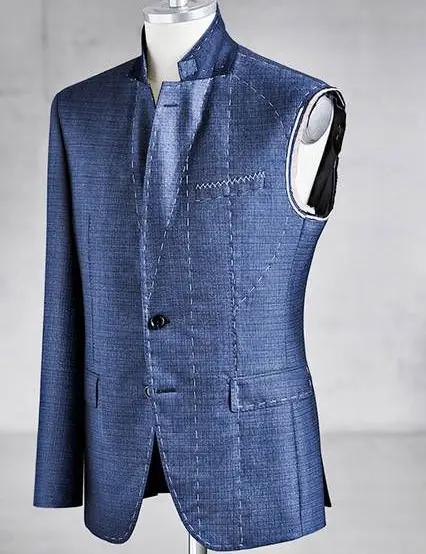
This is a jacket half-made: one sleeve on, the canvas still visible, the whole thing held together in white tacking thread. It looks unfinished because it is, and that is the point — at this stage the pattern itself can still be changed.
Once a garment is finished, the pattern is fixed and only the cloth can be moved. A seam can be let out or taken in; a shoulder that sits wrong cannot be rescued. Everything a fitting can genuinely fix, it fixes here.
It is also the step a two-day promise has to remove, because there is no way to baste, fit, unpick and finish a jacket in forty-eight hours. When a shop in this city quotes that, the basted fitting is what has been taken out.
Fittings, and how many
Fittings are not a fixed ritual; they are however many it takes. What each one is for is more useful than a number:
- The basted fitting changes the pattern
- Later fittings refine the cloth against the corrected pattern
- The last one confirms the finish — length, buttons, how it closes
How many your garment needs depends on the garment and on you, and it is agreed at the first appointment rather than promised on a website.
Alterations afterwards
Bodies change and garments are supposed to survive that. Because the pattern is kept, a later alteration starts from your original draft rather than from a guess at what it was.
More on alterations afterwards.
Where the appointments happen
- Your hotel, at a time that fits around the rest of a trip
- Your office, between meetings
- Your home, anywhere in Bangkok
All Bangkok - fittings at the customer's hotel, office or residence. More onwhere we come to you.
What we will tell you before you order
Three things, without being asked, because they are what decide whether the garment is what you think you are buying:
- How the jacket is constructed — see cloth and construction
- What the cloth will do in this climate, including when it is the wrong choice
- Whether your dates make the garment possible, before the cloth is cut
What our customers say
I had an amazing experience!! The tailor kept in contact with me regularly and organized fitting and adjustments times. Very professional and talented. I ended up getting two suits, and he held them for me while I travelled to Koh Samui, then had the items sent to my hotel near BKK airport. Extremely friendly and I would definitely recommend him to anyone looking to have a suit tailored!
Heather HeartlessRead it on Google
Mr Sam at The Boss Tailor in Bangkok was very nice to do business with. I ordered linnen shirts and trousers, had my measurements taken - and the day after the clothes where finished. Both shirts and trousers fit perfectly, the quality is very good! I can only recommend Mr Sam and The Boss Tailor in Bangkok !!!
Lars HalbergRead it on Google
Book a fitting
Tell us where you are and when suits you. We bring the cloth.
The Boss Tailor · All Bangkok - fittings at the customer's hotel, office or residence ·+66911051152 ·On Google
Questions we are actually asked
- Is bespoke worth it over made-to-measure?
- They are different things, and the honest answer depends on your shape. Made-to-measure adjusts an existing block to your measurements; bespoke drafts a pattern from them. If a standard block already suits you, made-to-measure gets close for less work. If it does not — a sloped shoulder, a fuller chest, a long rise — no amount of adjustment to a block fixes it, and that is where bespoke earns its cost.
- What is the 5 suit rule?
- People mean different things by it, so treat it as a rotation principle rather than a rule: enough suits that none is worn on consecutive days. A suit needs a day to recover, and two worn alternately outlast three worn back to back. The number that follows from that depends on how often you wear one.
- How many fittings will I need?
- It depends on the garment and on you, and it is agreed at the first appointment. What matters more than the count is that one of them happens while the garment is still half-made — that is the fitting where the pattern can still change, and it is the one a rushed process removes.
- Do I have to come to a shop?
- No — the shop is closed and everything happens where you are. Every appointment takes place at your hotel, your office or your home, anywhere in Bangkok, and the finished garment is brought to you the same way. There is no premises to travel to and no waiting room to sit in.
- What if I have to leave before it is finished?
- Say so at the first appointment rather than the last. Tell us your departure date and we will tell you plainly what is possible before the cloth is cut, including when the answer is that it is not.